
By Move2Moz | Category: Investing in Mozambique
Something is shifting. Quietly, but unmistakably.
Across South Africa, the UK, the United States and Europe, a growing number of people are asking the same question — not out loud necessarily, but in the small hours, or on long drives, or when the news gets turned off for the night. The question is this: is there somewhere else?
Somewhere with space. With clean air and warm water. Somewhere you can own land, grow food, live simply and affordably, and not feel like you’re one policy decision away from losing everything you’ve worked for.
For thousands of people who have already made the move, that somewhere is Mozambique. And specifically, southern Mozambique — one of the most beautiful, fertile, affordable and genuinely undiscovered corners of the African continent.
This is not a fantasy. This is a life that people are living right now. And with the right guidance, it could be yours too.
The World That’s Pushing People Out
Let’s be honest about what’s driving this conversation, because it’s real and it matters.
For South Africans, the pressure has been building for years. Load shedding. Rising crime. A cost of living that erodes purchasing power month by month. And now, the Expropriation Act of 2025 — signed into law by President Ramaphosa in January 2025 — which introduces the legal framework for expropriation without compensation under specific circumstances. South Africa’s first test case is already heading to court in 2026, involving a 34-hectare property valued at up to R64 million, expropriated for nil compensation. Whether you believe the law is justified or not, the uncertainty it creates for property owners is real, and it is causing people to reconsider where they put their assets and their futures.
For Americans and Europeans, the pressures are different but equally unsettling. Inflation has eaten into savings. Housing is unaffordable for entire generations. Political polarisation has reached levels that feel genuinely destabilising. Supply chain fragility — exposed brutally by the pandemic — has made food security feel less certain than it once did. And an increasing number of people, across the political spectrum, are quietly exploring what it would mean to own land, grow their own food, and opt out of a system that feels increasingly rigged against the individual.
Mozambique sits at the intersection of everything these people are looking for.
What Makes Southern Mozambique Different
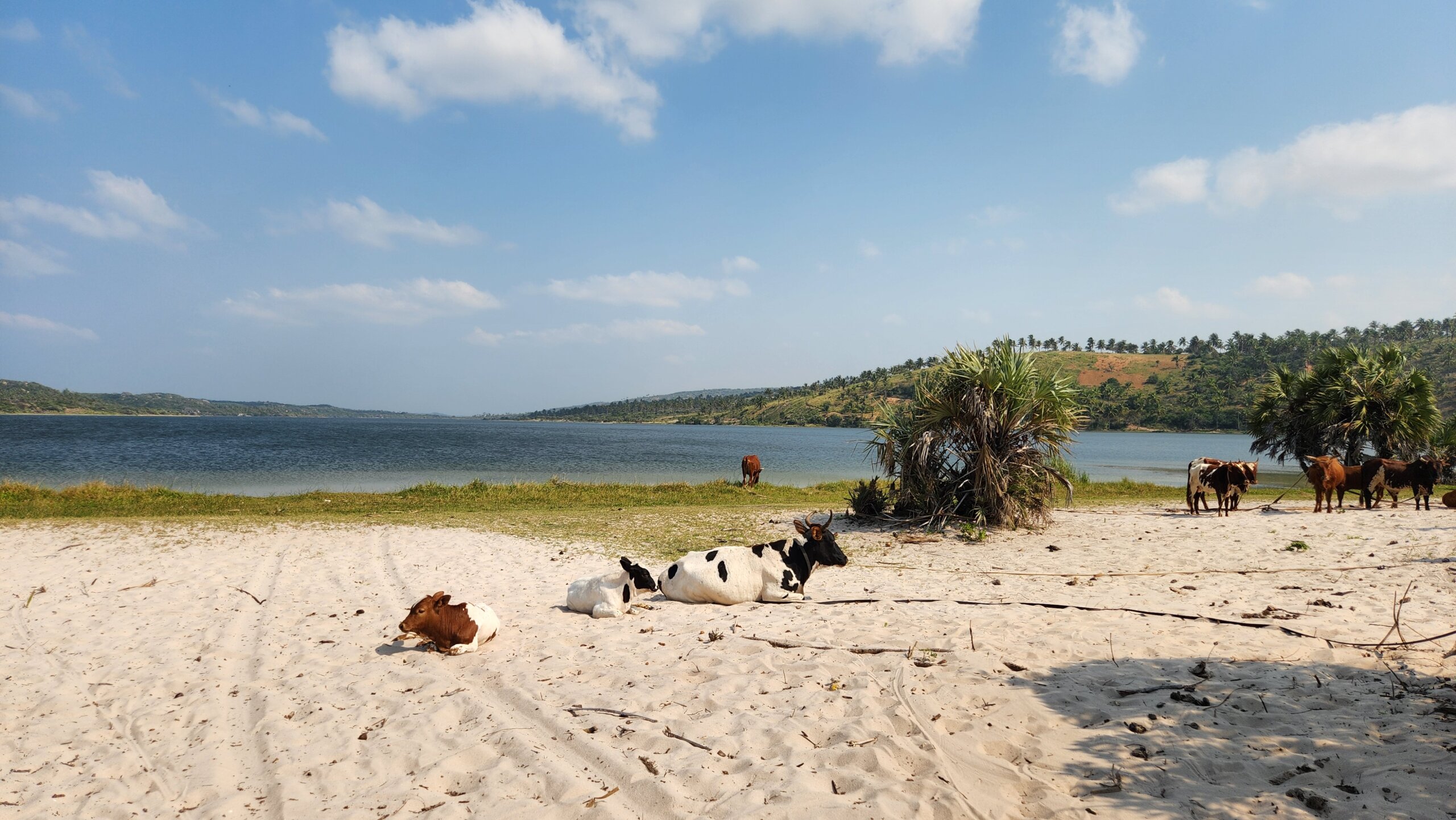
Drive through southern Mozambique and something happens to you. The pace slows. The road winds through landscapes that feel like they haven’t changed in decades — lush dune forests, coconut palms, small communities going about their days with a warmth and unhurriedness that feels almost nostalgic to anyone who grew up before the smartphone era.
This is not underdevelopment dressed up as charm. Mozambique is a young democracy, still in many ways recovering from a turbulent past — decades of colonial rule, a brutal civil war that ended only in 1992, and the long, slow work of rebuilding that follows. What that history has produced, perhaps unexpectedly, is a country that has not yet been overrun. A place where life is still lived at a human scale.
The biodiversity alone is extraordinary. Southern Mozambique’s coastline — stretching through Inhambane Province and beyond — is home to whale sharks, manta rays, humpback whales, pristine coral reefs, freshwater lakes, and dune forests teeming with wildlife. Driving between properties can genuinely feel like a jungle adventure. The Indian Ocean is warm year round. The soil is fertile. The sun shines reliably.
And because Mozambique has long been perceived as a terra incognita — a place people assume is complicated, or remote, or too unknown to risk — it has been largely spared the rapid development and exploitation that has consumed so much of the African coastline. That perception has, paradoxically, been its greatest protector.
The charm is intact. The land is still affordable. The communities are still real.
But this will not last forever. The people who move now are the ones who will look back in ten years and say they got there at exactly the right time.
The Self-Sufficiency Case for Southern Mozambique
For anyone seriously considering a more self-sufficient lifestyle, southern Mozambique makes a compelling case on almost every measure.
The climate is ideal for growing food year round. The warm, tropical climate of Inhambane Province supports a wide range of crops — coconuts, cashews, tropical fruits, vegetables, maize and much more. Many properties in the region already have established food-producing trees and gardens. The growing season effectively never ends.
Land is genuinely affordable. Compared to South Africa, Europe or the United States, agricultural and residential land in southern Mozambique represents extraordinary value. For the price of a modest apartment in Cape Town or a small plot in rural England, you can own a substantial piece of productive coastal land in Mozambique — with ocean views.
Water security is manageable. Most established properties in the region operate on borehole water, which is reliable and clean. Many run fully or partially on solar power. Off-grid living is not an aspiration here — it is standard practice for thousands of existing residents, both local and foreign.
The food is extraordinary and local. Fresh prawns, crayfish, line fish, tropical fruit, locally grown vegetables — the food culture of coastal Mozambique is one of its great unsung pleasures. Living off the land and sea here is not hardship. It is genuinely one of the best ways to eat on the planet.
The community already exists. This is perhaps the most important point for anyone nervous about making a big leap. Southern Mozambique already has a well-established community of foreign residents — South Africans, Portuguese, British, Dutch and others — who have built homes, started businesses, raised families and made this their permanent base. The infrastructure of expat life is already here. You would not be pioneering alone. You would be joining something that already works.
What About the Practical Reality?
We believe in honesty. So here is the complete picture.
Mozambique is a developing country. Infrastructure varies. Connectivity has been transformed by the widespread adoption of Starlink among the expat community — reliable, fast internet is no longer a barrier to remote working or staying connected. Healthcare requires planning — comprehensive international health insurance with medical evacuation cover is essential, and serious medical situations typically require a short flight to South Africa. Bureaucracy requires patience and good local guidance.
These are real considerations. They are not dealbreakers — thousands of foreigners navigate them successfully every day — but they require a realistic mindset and proper preparation.
The good news is that Move2Moz handles the practical side of the move. From property purchase and ownership transfer to company registration, VISA applications, work permits and relocation logistics — we are on the ground in Mozambique, and we have guided hundreds of buyers and relocators through every step of the process.
Nobody who has worked with us has faced these challenges alone.
What Mozambique Offers That Almost Nowhere Else Can
Let’s bring it back to the essential point.
Southern Mozambique offers a combination of things that is genuinely rare in today’s world:
Affordable land with clear legal title. Foreign nationals can own property in Mozambique. The legal framework is sound and well established. And unlike South Africa, Mozambique’s Private Investment Law explicitly prohibits expropriation without fair market compensation — a protection that is written into law and enforceable through international arbitration.
A climate and landscape that supports true self-sufficiency. Warm year round. Fertile soil. Abundant seafood. Year-round growing season. Solar energy that actually works.
A pace and quality of life that has largely disappeared elsewhere. Slower. Simpler. Safer than most people expect. A genuine sense of community. An environment of extraordinary natural beauty that reminds you why life is worth living.
An investment that still makes sense. Because Mozambique is still early — because the world hasn’t fully discovered it yet — the entry prices still reflect that. In five or ten years, they won’t.
The People Who Came Before You
The most common thing we hear from people who have made the move to Mozambique is some version of the same sentence: I wish I’d done this sooner.
Some came for a holiday and never left. Some bought a small property as a bolt-hole and ended up relocating permanently. Some came for retirement and found themselves more active, more fulfilled and more connected to life than they had been in decades.
The fear of the unknown is real. The leap is significant. But it is a leap that has been made successfully by hundreds of people before you — people who are now living the life you’re imagining — and it is a leap that Move2Moz exists to help you make safely and confidently.
Ready to Find Out More?
If this has resonated with you — even quietly, even tentatively — the next step is simply to have a conversation.
Browse our current property listings — including homes, farms, lodges and coastal land across southern Mozambique.
Read our complete guide to buying property in Mozambique as a foreigner — everything you need to know about the legal process, ownership structures and what to expect.
Or get in touch with us directly — we’re based here, we know this land intimately, and we’re always happy to have an honest conversation about whether Mozambique is the right fit for you.
Want the complete investor’s guide to buying land and property in Mozambique? The MozInvest Guide covers ownership law, DUAT structures, company formation, tax obligations and investor protections in comprehensive detail — everything you need to make a fully informed decision. 👉 Get the MozInvest Guide
Move2Moz is a fully accredited Mozambique property agency based in Inhambane Province. We have been helping foreign buyers purchase, transfer and manage property in Mozambique since 2016. This article contains general information only and does not constitute legal or financial advice. We recommend seeking independent professional advice for your specific situation.
